Van Gogh spent his early adult life working for a firm of art dealers. After a brief spell as a teacher, he became a missionary worker in a very poor mining region. He did not embark upon a career as an artist until 1880. Initially, Van Gogh worked only with sombre colours, until he encountered Impressionism and Neo-Impressionism in Paris. He incorporated their brighter colours and style of painting into a uniquely recognizable style, which was fully developed during the time he spent at Arles, France. He produced more than 2,000 works, including around 900 paintings and 1,100 drawings and sketches, during the last ten years of his life. Most of his best-known works were produced in the final two years of his life, during which time he cut off part of his left ear following a breakdown in his friendship with Paul Gauguin. After this he suffered recurrent bouts of mental illness, which led to his suicide.
The central figure in Van Gogh's life was his brother Theo, who continually and selflessly provided financial support. Their lifelong friendship is documented in numerous letters they exchanged from August 1872 onwards. Van Gogh is a pioneer of what came to be known as Expressionism. He had an enormous influence on 20th century art, especially on the Fauves and German Expressionists.
Biography
Early life (1853–1869)
Vincent Willem van Gogh was born in Groot-Zundert, a village close to Breda in the Province of North Brabant in the southern Netherlands. Van Gogh was the son of Anna Cornelia Carbentus and Theodorus van Gogh, who was a minister of the Dutch Reformed Church. He was given the same name as his grandfather—and a first brother stillborn exactly one year before. It has been suggested that being given the same name as his dead elder brother might have had a deep psychological impact on the young artist, and that elements of his art, such as the portrayal of pairs of male figures, can be traced back to this. The practice of reusing a name in this way was not uncommon. The name "Vincent" was often used in the Van Gogh family: the baby's grandfather was called Vincent van Gogh (1789-1874); he had received his degree of theology at the University of Leiden in 1811. Grandfather Vincent had six sons, three of whom became art dealers, including another Vincent, referred to in Van Gogh's letters as "Uncle Cent." Grandfather Vincent had perhaps been named after his own father's uncle, the successful sculptor Vincent van Gogh (1729-1802). Art and religion were the two occupations to which the Van Gogh family gravitated.
Four years after Van Gogh was born, his brother Theodorus (Theo) was born on 1 May 1857. There was also another brother named Cor and three sisters, Elisabeth, Anna and Wil. As a child, Van Gogh was serious, silent and thoughtful. In 1860 he attended the Zundert village school, where the only teacher was Catholic and there were around 200 pupils. From 1861 he and his sister Anna were taught at home by a governess, until 1 October 1864, when he went away to the elementary boarding school of Jan Provily in Zevenbergen, the Netherlands, about 20 miles (32 km) away. He was distressed to leave his family home, and recalled this even in adulthood. On 15 September 1866, he went to the new middle school, Willem II College in Tilburg, the Netherlands. Constantijn C. Huysmans, who had achieved a certain success himself in Paris, taught Van Gogh to draw at the school and advocated a systematic approach to the subject. In March 1868 Van Gogh abruptly left school and returned home. His comment on his early years was: "My youth was gloomy and cold and sterile
Vincent Willem van Gogh was born in Groot-Zundert, a village close to Breda in the Province of North Brabant in the southern Netherlands. Van Gogh was the son of Anna Cornelia Carbentus and Theodorus van Gogh, who was a minister of the Dutch Reformed Church. He was given the same name as his grandfather—and a first brother stillborn exactly one year before. It has been suggested that being given the same name as his dead elder brother might have had a deep psychological impact on the young artist, and that elements of his art, such as the portrayal of pairs of male figures, can be traced back to this. The practice of reusing a name in this way was not uncommon. The name "Vincent" was often used in the Van Gogh family: the baby's grandfather was called Vincent van Gogh (1789-1874); he had received his degree of theology at the University of Leiden in 1811. Grandfather Vincent had six sons, three of whom became art dealers, including another Vincent, referred to in Van Gogh's letters as "Uncle Cent." Grandfather Vincent had perhaps been named after his own father's uncle, the successful sculptor Vincent van Gogh (1729-1802). Art and religion were the two occupations to which the Van Gogh family gravitated.
Four years after Van Gogh was born, his brother Theodorus (Theo) was born on 1 May 1857. There was also another brother named Cor and three sisters, Elisabeth, Anna and Wil. As a child, Van Gogh was serious, silent and thoughtful. In 1860 he attended the Zundert village school, where the only teacher was Catholic and there were around 200 pupils. From 1861 he and his sister Anna were taught at home by a governess, until 1 October 1864, when he went away to the elementary boarding school of Jan Provily in Zevenbergen, the Netherlands, about 20 miles (32 km) away. He was distressed to leave his family home, and recalled this even in adulthood. On 15 September 1866, he went to the new middle school, Willem II College in Tilburg, the Netherlands. Constantijn C. Huysmans, who had achieved a certain success himself in Paris, taught Van Gogh to draw at the school and advocated a systematic approach to the subject. In March 1868 Van Gogh abruptly left school and returned home. His comment on his early years was: "My youth was gloomy and cold and sterile
Art dealer and preacher (1869–1878)
 In July 1869, at the age of fifteen, he obtained a position with the art dealer Goupil & Cie in The Hague through his Uncle Vincent ("Cent"), who had built up a good business which became a branch of the firm. After his training, Goupil transferred him to London in June 1873, where he lodged at 87 Hackford Road, Brixton and worked at Messrs. Goupil & Co., 17 Southampton Street.This was a happy time for Van Gogh: he was successful at work, and was already, at
the age of 20, earning more than his father. He fell in love with his landlady's daughter, Eugénie Loyer, but when he finally confessed his feeling to her, she rejected him, saying that she was already secretly engaged to a previous lodger. Vincent became increasingly isolated and fervent about religion. His father and uncle sent him to Paris, where he became resentful at how art was treated as a commodity, and he manifested this to the customers. On 1 April 1876, it was agreed that his employment should be terminated.
His religious emotion grew to the point where he felt he had found his true vocation in life, and he returned to England to do unpaid work, first as a supply teacher in a small boarding school overlooking the harbour in Ramsgate; he made some sketches of the view. The proprietor of the school relocated to Isleworth, Middlesex. Vincent decided to walk to the new location. This new position did not work out, and Vincent became a nearby Methodist minister's assistant in wanting to "preach the gospel everywhere."
At Christmas that year he returned home, and then worked in a bookshop in Dordrecht for six months, but he was not happy in this new position and spent most of his time in the back of the shop either doodling, or translating passages from the Bible into English, French, and German. His roommate from this time, a young teacher called Görlitz, later recalled that Vincent ate frugally, preferring to eat no meat. In an effort to support his wish to become a pastor, his family sent him to Amsterdam in May 1877 where he lived with his uncle Jan van Gogh, a rear admiral in the navy. Vincent prepared for university, studying for the theology entrance exam with his uncle Johannes Stricker, a respected theologian who published the first "Life of Jesus" available in the Netherlands. Vincent failed at his studies and had to abandon them. He left uncle Jan's house in July 1878. He then studied, but failed, a three-month course at the Protestant missionary school (Vlaamsche Opleidingsschool) in Laeken, near Brussels.
Borinage and Brussels (1879–1880)
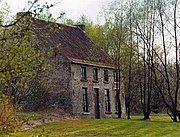
In January 1879 Van Gogh got a temporary post as a missionary in the village of Petit Wasmes]in the coal-mining district of Borinage in Belgium, bringing his father's profession to people felt to be the most wretched and hopeless in Europe. Taking Christianity to what he saw as its logical conclusion, Vincent opted to live like those he preached to, sharing their hardships to the extent of sleeping on straw in a small hut at the back of the baker's house where he was billetedthe baker's wife used to hear Vincent sobbing all night in the little hut His choice of squalid living conditions did not endear him to the appalled church authorities, who dismiss ed him for "undermining the dignity of the priesthood." After this he walked to Brusselsreturned briefly to the Borinage, to the village of Cuesmes, but acquiesced to pressure from his parents to come "home" to Etten. He stayed there until around March the following year to the increasing concern and frustration of his parents. There was considerable conflict between Vincent and his father, and his father made enquiries about having his son committed to a lunatic asylum at Geel Vincent fled back to Cuesmes where he lodged with a miner named Charles Decrucq, with whom he stayed until October. He became increasingly interested in the everyday people and scenes around him, which he recorded in drawings.
In 1880, Vincent followed the suggestion of his brother Theo and took up art in earnest. In autumn 1880, he went to Brussels, intending to follow Theo's recommendation to study with the prominent Dutch artist Willem Roelofs, who persuaded Van Gogh (despite his aversion to formal schools of art) to attend the Royal Academy of Art. There he not only studied anatomy, but the standard rules of modelling and perspective, all of which, he said, "you have to know just to be able to draw the least thing." Vincent wished to become an artist while in God's service as he stated, "to try to understand the real significance of what the great artists, the serious masters, tell us in their masterpieces, that leads to God; one man wrote or told it in a book; another in a picture.
 ed him for "undermining the dignity of the priesthood." After this he walked to Brusselsreturned briefly to the Borinage, to the village of Cuesmes, but acquiesced to pressure from his parents to come "home" to Etten. He stayed there until around March the following year to the increasing concern and frustration of his parents. There was considerable conflict between Vincent and his father, and his father made enquiries about having his son committed to a lunatic asylum at Geel Vincent fled back to Cuesmes where he lodged with a miner named Charles Decrucq, with whom he stayed until October. He became increasingly interested in the everyday people and scenes around him, which he recorded in drawings.
In 1880, Vincent followed the suggestion of his brother Theo and took up art in earnest. In autumn 1880, he went to Brussels, intending to follow Theo's recommendation to study with the prominent Dutch artist Willem Roelofs, who persuaded Van Gogh (despite his aversion to formal schools of art) to attend the Royal Academy of Art. There he not only studied anatomy, but the standard rules of modelling and perspective, all of which, he said, "you have to know just to be able to draw the least thing." Vincent wished to become an artist while in God's service as he stated, "to try to understand the real significance of what the great artists, the serious masters, tell us in their masterpieces, that leads to God; one man wrote or told it in a book; another in a picture.
Etten (1881)
In April 1881, Van Gogh went to live in the countryside with his parents in Etten and continued drawing, using neighbours as subjects. Through the summer he spent much time walking and talking with his recently widowed cousin, Kee Vos-Stricker, the daughter of his mother's older sister and Johannes Stricker, who had shown real warmth towards his nephew. Kee was seven years older than Vincent, and had an eight-year-old son. Vincent proposed ma rriage, but she flatly refused with the words: "No, never, never" (niet, nooit, nimmer). At the end of November he wrote a strong letter to Uncle Stricker, and then, very soon after, hurried to Amsterdam where he talked with Stricker again on several occasions, but Kee refused to see him at all. Her parents told him "Your persistence is disgusting". In desperation he held his left hand in the flame of a lamp, saying, "Let me see her for as long as I can keep my hand in the flame." He did not clearly recall what happened next, but assumed that his uncle blew out the flame. Her father, "Uncle Stricker," as Vincent refers to him in letters to Theo, made it clear that there was no question of Vincent and Kee marrying, given Vincent's inability to support himself financially. What he saw as the hypocrisy of his uncle and former tutor affected Vincent deeply. At Christmas he quarreled violently with his father, even refusing a gift of money, and immediately left for The Hague.
 rriage, but she flatly refused with the words: "No, never, never" (niet, nooit, nimmer). At the end of November he wrote a strong letter to Uncle Stricker, and then, very soon after, hurried to Amsterdam where he talked with Stricker again on several occasions, but Kee refused to see him at all. Her parents told him "Your persistence is disgusting". In desperation he held his left hand in the flame of a lamp, saying, "Let me see her for as long as I can keep my hand in the flame." He did not clearly recall what happened next, but assumed that his uncle blew out the flame. Her father, "Uncle Stricker," as Vincent refers to him in letters to Theo, made it clear that there was no question of Vincent and Kee marrying, given Vincent's inability to support himself financially. What he saw as the hypocrisy of his uncle and former tutor affected Vincent deeply. At Christmas he quarreled violently with his father, even refusing a gift of money, and immediately left for The Hague.
Drenthe and The Hague (1881–1883)
In January 1882 he settled in The Hague, where he called on his cousin-in-law, the painter Anton Mauve, who encouraged him towards painting. He soon fell out with Mauve, however, perhaps over the issue of drawing from plaster casts; Mauve appeared suddenly to go cold towards Vincent, not returning a couple of his letters. Vincent guessed that Mauve had learned of his new domestic relationship with the alcoholic prostitute, Clasina Maria Hoornik (born February 1850, The Hague; she was known as Sien) and her young daughter.Van Gogh had met Sien towards the end of January.Sien had a five year-old daughter, and was pregnant. She had already had two other children who had died, although Vincent was unaware of this.On 2 July, Sien gave birth to a baby boy, Willem.When Vincent's father discovered the details of this relationship, considerable pressure was put on Vincent to abandon Sien and her children. Vincent was at first defiant in the face of his family's opposition.
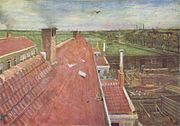
His uncle Cornelis, an art dealer, commissioned 20 ink drawings of the city from him; they were completed by the end of May. In June Vincent spent three weeks in a hospital suffering gonorrhoea. In the summer, he began to paint in oil. In autumn 1883, after a year with Sien, he abandoned her and the two children. Vincent had thought of moving the family away from the city, but in the end he made the break. It is possible that lack of money had pushed Sien back to prostitution; the home had become a less happy one, and Vincent may have felt family life was irreconcilable with his artistic development. When Vincent left, Sien gave her daughter to her mother, and baby Willem to her brother, and moved to Delft and then Antwerp.Willem remembered being taken to visit his mother in Rotterdam at around the age of 12, where his uncle tried to persuade Sien to marry in order to legitimize the child. Willem remembered his mother saying: "But I know who the father is. He was an artist I lived with nearly 20 years ago in The Hague. His name was Van Gogh." She then turned to Willem and said "You are called after him." Willem believed himself to be Van Gogh's son, but the timing of the birth makes this unlikely.In 1904 Sien drowned herself in the river Scheldt.
Van Gogh moved to the Dutch province of Drenthe in the north of the Netherlands, and in December, driven by loneliness, to stay with his parents who were by then living in Nuenen, North Brabant, also in the Netherlands.
Van Gogh moved to the Dutch province of Drenthe in the north of the Netherlands, and in December, driven by loneliness, to stay with his parents who were by then living in Nuenen, North Brabant, also in the Netherlands.


